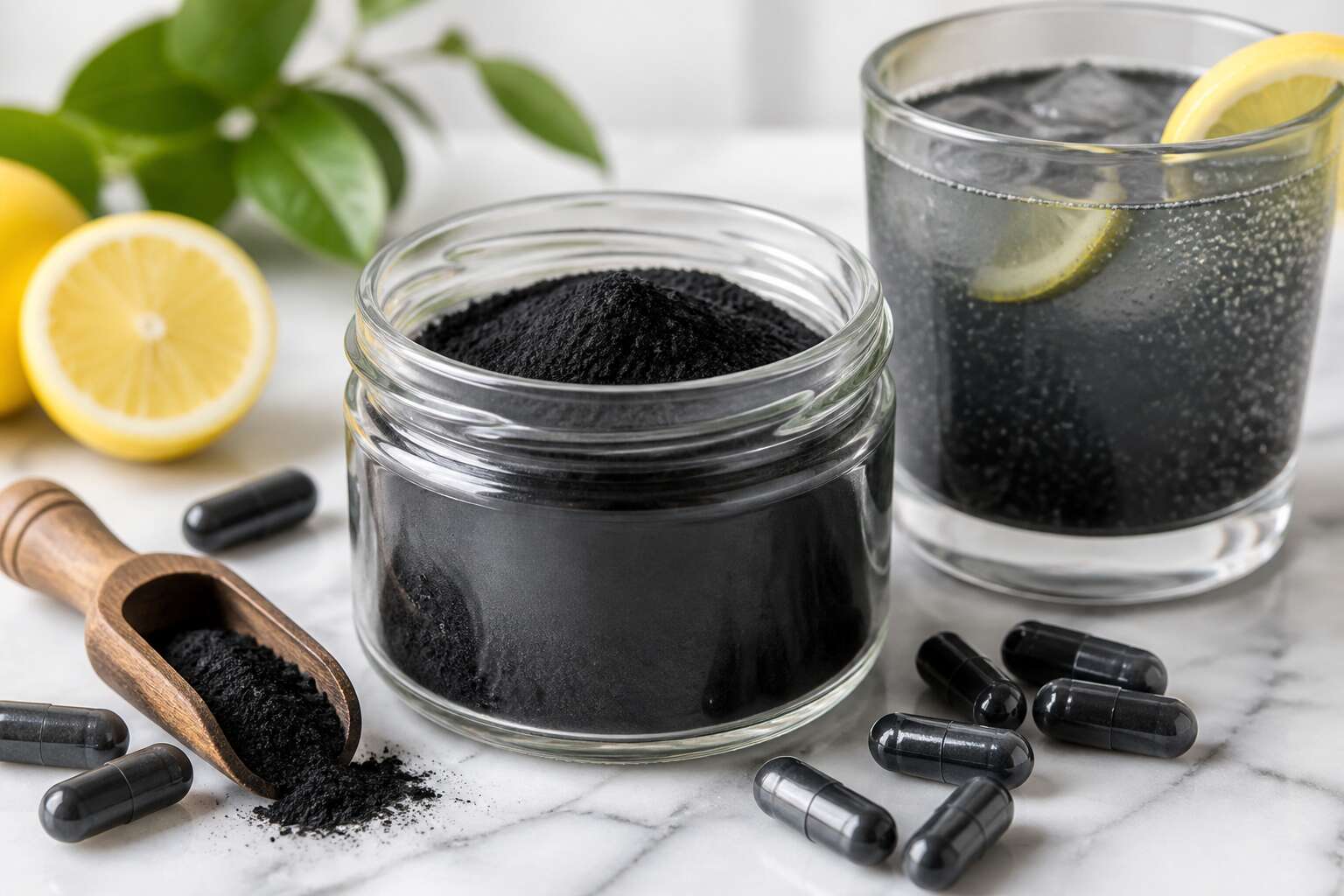
The Science Behind Activated Charcoal
Adsorption vs. Absorption
To understand when does activated charcoal work, you must first grasp the difference between adsorption and absorption. Adsorption is a surface phenomenon. Activated charcoal’s porous structure, which can yield up to 3000 square meters per gram, traps molecules through van der Waals forces. This binding holds toxins in place, reducing their concentration in the gut lumen.
Absorption, in contrast, involves a substance moving into the interior of another medium. Activated charcoal does not absorb; it adsorbs! In clinical practice, I have seen this distinction dictate whether a patient receives charcoal or a different treatment. Charcoal works only if it reaches the toxin before absorption into the bloodstream. That timing is the core of efficacy.
The Role of Porous Structure
The porous structure of activated charcoal is its defining feature. Each gram contains a labyrinth of microscopic channels, a network so vast it defies the eye. This surface area, up to 3000 square meters per gram, creates the conditions for molecular capture.
Pore size determines the outcome:
- Micropores trap smaller molecules.
- Mesopores handle larger ones.
- Macropores allow passage to deeper channels.
When does activated charcoal work? It works when the toxin fits the pore geometry. A mismatch means the molecule passes through untouched.
I have seen patients assume charcoal is universal. It is not. The structure dictates the result, and timing remains the master variable.
How Charcoal Binds to Harmful Substances
In the quiet collision between poison and porous carbon, a strange chemistry unfolds. The moment of contact is everything. When does activated charcoal work? It works in that fleeting window before a toxin settles too deeply into the body’s embrace. The binding is not a simple grip. It is an electrostatic dance, a pull between the molecule and the carbon’s charged surface. Harmful substances, often carrying a slight charge themselves, find themselves ensnared by forces they cannot resist. This is adsorption, a process where particles cling to the exterior of the charcoal’s vast internal landscape.
The effectiveness of this process hinges on a delicate balance of chemistry. Certain compounds are more susceptible to capture, particularly those with larger molecular weights. The attraction is governed by several key forces:
1. Van der Waals forces, the weak yet abundant attractions that arise from momentary fluctuations in electron density.
2. Electrostatic interactions, which draw oppositely charged molecules closer to the carbon surface.
3. Hydrogen bonding, which can tether certain polar toxins in place.
Temperature and the surrounding pH play their parts too, altering the charge and shape of the molecules in transit. A molecule that is uncharged and nonpolar often finds a more willing host in the carbon. When the environment shifts too acidic or too alkaline, the charcoal’s capacity wanes. It is a selective trap, not a sieve. For the toxin to be pulled from the digestive tract, it must first be drawn to the surface and held there long enough to be carried out of the body. When does activated charcoal work then? It works when the chemistry aligns, when the molecule is willing to let go of its watery surroundings and cling to the dark, waiting lattice. The artistry lies in the match, not in the volume of the charcoal consumed.
Critical Timing for Maximum Effectiveness
The Golden Window After Ingestion
The clock starts ticking the moment that gritty slurry crosses your lips. Clinical data from poison control centres indicates that charcoal’s binding peak occurs within sixty minutes of ingestion. Beyond that hour, the toxin has often slipped through the pyloric sphincter into the small intestine, where the charcoal cannot follow.
Understanding when does activated charcoal work requires you to map the poison’s journey, not the charcoal’s. If the stomach lining has already absorbed the compound, the charcoal arrives late and delivers nothing. An empty stomach offers the clearest window, but food slows gastric emptying in unpredictable ways.
Several variables distort that sixty minute benchmark:
- whether the substance coats the gastric wall,
- the chemical structure of the ingested poison,
- the volume of liquid swallowed with the dose.
Each alters the rate of gastric transit, shifting the moment when the charcoal loses its usefulness. The practical window, then, is less a fixed hour and more a direct function of how quickly absorption outruns binding.
Early Administration vs. Delayed Use
Timing determines whether charcoal works or merely passes through. Early dosing intercepts the toxin while it still sits in the gastric pool, unabsorbed and vulnerable. The charcoal binds it there, preventing systemic absorption.
Delayed dosing is a different matter entirely. The toxin has moved on, the binding sites in the charcoal are still available, but the target is gone. This is not a failure of the charcoal. It is a failure of timing!
What changes between early and delayed use:
- The toxin’s location shifts from the stomach to the bloodstream
- The concentration gradient reverses
- The opportunity for intervention collapses
When does activated charcoal work? It works in the moments before absorption takes over. Emergency departments across South Africa operate on this principle. The best outcomes follow the fastest decisions.
Duration of Action in the Body
Repeated Dosing Considerations
The precise moment of intervention dictates everything. A single dose rarely settles the matter. When does activated charcoal work best? It works when the first dose arrives early, but sustained exposure requires more. After binding, the free substance may redistribute from fat stores or release from capsules.
Critical timing for maximum effectiveness depends on this. Repeated dosing considerations hinge on the half life of both toxin and charcoal. Common practice includes:
- Administering a second dose after four to six hours.
- Monitoring serum levels to avoid rebound toxicity.
- Adjusting intervals based on the poison’s kinetics.
For many agents, a second or third dose proves necessary! The gut is not passive; it pulses with peristaltic waves. Dose too soon, and you bind only the charcoal’s surface. Dose too late, and the substance has crossed into the system. That is when does activated charcoal work, when you respect its rhythm.
Factors That Influence Activation
Presence of Food in the Stomach
The psyche craves certainty, especially in moments of physiological distress. We want to believe that swallowing a charcoal capsule is a binary event: it either works completely, or it fails entirely. The reality is far more nuanced, a complex interplay of chemistry and timing that mirrors the messy, non-linear way we often make decisions in our own lives. The substance’s efficacy is not fixed; it is contingent upon a specific set of physiological variables that determine whether the porous particles have a chance to bind with the offending toxins. This is why the question of when does activated charcoal work has no single, simple answer.
The most significant variable in this clinical equation is the physical state of the stomach itself. The presence of food acts as a powerful disruptor, turning a potential adsorption event into a chaotic race. If the stomach is empty, the charcoal has unimpeded access to the toxin, allowing for rapid binding. However, a full stomach introduces competing proteins, fats, and carbohydrates, all vying for space within the charcoal’s microscopic pores. This competition reduces the available surface area for the intended target, thereby diminishing the overall binding capacity. We must also consider the timing of the ingestion.
Here is the crux of the timing issue, broken down into the critical factors that dictate effectiveness:
- The volume of the meal: A small snack versus a large meal creates drastically different environments, with a larger meal significantly delaying gastric emptying.
- The time elapsed since ingestion: The longer the delay, the further the toxin travels into the intestinal tract, moving beyond the point where charcoal can intervene.
- Gastric motility: The natural speed of your digestive system dictates how long the toxin remains in contact with the charcoal within the stomach.
This is where the psychological desperation of the moment meets the biological reality of the body. While we might hope for an instantaneous fix, the physiological window is frustratingly shallow. It is a stark reminder that our attempts to exert control over our internal processes are often limited by the slow, patient mechanics of absorption and digestion. The greatest efficacy is achieved when the charcoal and the toxin are present in the stomach simultaneously, a condition that becomes increasingly difficult to satisfy as time passes. Ultimately, the answer to when does activated charcoal work rests not on a hopeful wish, but on a pragmatic assessment of gastric contents and the relentless ticking of the biological clock.
The Type and Form of Toxin
Some toxins are clingy. Others are the equivalent of that guest who refuses to leave the party. This matters because charcoal is not a universal solvent, despite what the wellness aisle implies. It is a selective binder, and the answer to when does activated charcoal work depends heavily on the culprit’s molecular profile.
Large molecules, like most pesticide residues, get trapped easily. Small, charged ions, such as those found in some metal poisonings, often slip right through the pores. Consider the following characteristics that dictate success:
– Molecular size: Larger compounds fit the cavities better.
– Electrical charge: Neutral or weakly charged toxins bind more readily.
– Solubility: Water-soluble toxins are problematic, as charcoal prefers fat-soluble partners.
So, that questionable braai meat might be fine, but a dodgy cocktail could outsmart the charcoal entirely. It is a finicky chemistry set, not a magic eraser. The real test of when does activated charcoal work is whether the toxin happens to be the right shape for the microscopic parking spot. A mismatched pair means the charcoal simply passes through, a polite but useless passenger. Context is everything.
Gastric Motility and Digestion Rate
The speed at which your stomach empties can make or break the treatment. Think of it as a race between the charcoal and the toxin, with your gut as the track. If digestion is sluggish, the charcoal has more time to intercept its target. A rapid transit time, however, narrows that window significantly. This is a core part of understanding when does activated charcoal work, as the physical journey matters as much as the chemical bond.
Gastric motility dictates the encounter rate. A full stomach slows the process, mixing the charcoal with the poison over a longer period. An empty stomach, by contrast, speeds things along, rushing both substances into the intestines where absorption is quicker. The outcome hinges on these variables:
– The rate of gastric emptying.
– The presence of peristaltic waves pushing contents forward.
– The specific formulation of the charcoal, which affects its residency time.
A slow, deliberate digestive phase gives the charcoal a fighting chance to perform its binding duties. A fast one might leave the charcoal trailing behind. Put simply, the conditions inside the gut determine the result. A quick pass through the system is a missed opportunity, while a prolonged stay offers a better outcome. That is the clinical reality of the situation, and it defines precisely when does activated charcoal work. A spicy bunny chow moving through quickly might beat the treatment, but a slow, heavy braai could give it the edge it needs.
Scenarios Where Activated Charcoal Falls Short
Corrosive Acids and Alkalis
Activated charcoal has a reputation as a universal remedy, but there is a marked exception. When does activated charcoal work? It works for specific toxins, not for corrosive acids and alkalis. These caustic compounds burn tissue on contact, before any adsorption can occur. Charcoal binds only to substances still in solution; it cannot undo chemical destruction.
Even worse, charcoal’s abrasiveness can irritate injured mucosa, and induced vomiting may tear an esophagealready weakened by acid. Medical guidelines omit charcoal for these exposures, favoring immediate dilution and endoscopic procedures. The porous lattice that traps typical poisons has no affinity for dissociated acid or base molecules, whose charged ions pass through without binding.
- Hydrochloric acid denatures proteins instantly
- Sodium hydroxide causes liquefactive necrosis
- Activated charcoal does not neutralize pH shifts
So when does activated charcoal work? In cases of corrosive ingestion, the answer is never, and knowing that distinction saves lives. Emergency treatment depends on gastric lavage and protective measures, not adsorption.
Alcohol, Heavy Metals, and Lithium
Some poisons are simply beyond charcoal’s reach. Alcohol, for instance, is absorbed from the stomach into the bloodstream with remarkable speed. By the time medical help arrives, the ethanol has already left the digestive tract, where charcoal works. When does activated charcoal work? Not for ethanol or methanol. The charcoal passes through without binding to these small, water-soluble molecules.
Heavy metals and lithium present another unique challenge. These elements exist as charged ions in the stomach’s acidic environment. The same porous lattice that captures organic toxins has little affinity for these charged particles.
– Lead, mercury, and arsenic ions slip through charcoal’s pores
– Lithium, a common medication, requires specific treatments
– Chelation therapy remains the standard for metallic poisoning
A person who ingests lithium tablets may find that charcoal does not adsorb the mineral effectively. The clinical reality is that dialysis, not adsorption, addresses lithium toxicity. When does activated charcoal work, then? It works when the toxin is organic, uncharged, and still sitting in the gastrointestinal tract. For alcohol, heavy metals, and lithium, the answer is never. Understanding this distinction prevents false confidence and directs patients toward treatments that truly help.
Non-Toxic or Low-Risk Ingestions
Not every ingestion warrants a charcoal slurry. A child who nibbles a crayon or an adult who drinks a glass of spoiled milk has consumed something low-risk. The body handles these quickly, and charcoal adds no benefit. It may even cause vomiting or constipation, which complicates an otherwise simple situation.
- Overdosing on vitamin C
- Eating too much table salt
- Swallowing a piece of gum
These cases resolve without intervention. Consider water-soluble vitamins. They dissolve in the gut and absorb readily. Charcoal cannot outpace that process. For these benign substances, the question of when does activated charcoal work has a simple answer: rarely. It is reserved for potent toxins, not for overeating or minor exposures.
Cyanide and Iron Overdoses
Consider a cyanide overdose. The toxin moves through the body with alarming speed, binding to cellular machinery within minutes. Charcoal cannot keep pace, as its adsorption capacity for cyanide is poor and unpredictable. Iron tablets present a different kind of failure. Charcoal does not bind iron effectively, and the metal’s corrosive nature demands medical intervention, not a slurry.
When does activated charcoal work? For these particular poisons, the honest answer is seldom. Clinicians turn instead to antidotes like hydroxocobalamin for cyanide or chelation therapy for iron. These treatments target the specific biochemical pathways, something charcoal cannot do.
Proper Medical Use and Monitoring
Clinical Evaluation Before Dosing
In a busy emergency unit, activated charcoal is not dispensed on impulse. A careful clinician first verifies the substance, the estimated time of ingestion, and the patient’s level of consciousness. The safer course demands evaluating the airway before any charcoal is given. That is when does activated charcoal work with any predictability. Without this assessment, the intervention can cause more harm than the poison itself.
Monitoring continues after dosing. Nurses watch for abdominal distension, vomiting, or signs of obstruction. Repeated doses require particular caution, especially in patients with kidney problems. Proper medical use means treating charcoal as a specific agent, not a universal remedy.
- Confirming the patient is awake and cooperative
- Checking for bowel sounds or prior surgery
- Reviewing the toxin’s known antidote profile
These checks turn a simple powder into a precise clinical decision.
Oral Administration vs. Tube Delivery
The clock is the most critical factor when asking when does activated charcoal work. In an emergency, the window for effective use is surprisingly narrow, typically within one hour after ingestion. The charcoal acts like a microscopic sponge, but it needs to reach the poison before your stomach does. If the poison has already moved into the small intestine, the charcoal arrives too late to make a meaningful difference.
Gastric motility, the speed at which the stomach empties, dictates the real deadline. A full stomach slows this process, which can extend the effective window for administration. Conversely, if the patient took the substance on an empty stomach, the poison may pass through the pyloric sphincter and into the bloodstream much faster, rendering the charcoal useless. Therefore, the answer to when does activated charcoal work is not a fixed number but a physiological race.
The type of toxin also determines efficacy. Activated charcoal binds poorly to alcohols, corrosive acids, and heavy metals like lithium. For these substances, the drug is ineffective. However, for most other pharmaceuticals, the mechanism is straightforward: the high surface area of the charcoal adsorbs the chemical, trapping it in the gut and preventing systemic absorption.
The critical factors include:
– Time since ingestion: Usually one hour or less.
– Stomach contents: Food slows gastric emptying.
– Type of poison: Charcoal is ineffective for alcohols and corrosives.
– Patient condition: Bowel sounds must be present.
The administration route matters as well. While oral ingestion is standard, a nasogastric tube is often necessary for uncooperative patients. Repeated doses create a concentration gradient that pulls the poison from the bloodstream back into the gut, a process called retrograde transfer. This makes serial dosing a viable strategy for specific toxins like theophylline or phenobarbital, but it is not a universal remedy.
Ultimately, the question of when does activated charcoal work is less about a strict minute count and more about the interplay of absorption kinetics and patient physiology. Without bowel sounds, the charcoal simply sits inert in a paralyzed intestine, adding no value. The clinician must assess these variables rapidly, because the answer to that timing question changes with every passing second and every unique patient presentation.
Mimicking a Standard Dose Schedule
In medical practice, the question of when does activated charcoal work extends beyond the emergency department and into the realm of careful clinical oversight. Once a physician decides to intervene, the focus shifts to administering the correct dose and observing the patient’s response with unwavering attention. This is not a passive treatment; it requires a proactive approach to ensure safety and efficacy.
Proper medical use involves a precise calculation based on the patient’s weight, typically aiming for a ratio of ten parts charcoal to every one part of the suspected poison. The slurry is often mixed with a laxative like sorbitol to hasten its passage through the gastrointestinal tract. However, this combination is not without risk, and healthcare providers must monitor for potential complications. For instance, bowel obstruction or perforation can occur, particularly in patients who have ingested a substance that slows intestinal movement.
The entire process demands a high level of vigilance. A healthcare professional must continuously check for the return of bowel sounds, as the charcoal’s effectiveness is nullified if the gut is paralyzed. They also need to manage the patient’s airway to prevent aspiration of the fine black powder, especially if the patient is drowsy or combative. The monitoring mimics a standard dose schedule, where the timing of subsequent charcoal doses is dictated by the body’s response, ensuring that the treatment adapts to the patient’s evolving clinical picture. Ultimately, the answer to when does activated charcoal work is found in this delicate balance between decisive action and sustained, careful observation.
Potential Side Effects and Safety Precautions
Once the charcoal slurry is given, the real work begins. Healthcare providers must track every response, from bowel sounds to stool output. A silent abdomen can mean the charcoal is not moving, while excessive stool signals sorbitol overuse. These observations answer a practical question: when does activated charcoal work depends entirely on the body’s ongoing reaction.
- Monitor airway reflexes to prevent aspiration of the powder.
- Record fluid balance to catch dehydration from laxatives.
- Check stool for charcoal passage, which confirms intestinal transit.
Electrolyte shifts are common, particularly in children and older adults. Vomiting also complicates matters, as the dose may be lost or inhaled. Safety precautions are therefore not static. They shift with the patient’s level of consciousness and gut function. In practice, when does activated charcoal work is decided at the bedside, through repeated checks and dose adjustments, not by a fixed schedule alone.
When to Seek Emergency Care
In the chaotic theatre of an emergency room, the question of when does activated charcoal work is answered with a clock and a stethoscope. It isn’t a magic bullet; it’s a tool wielded with precision. For it to be effective, medical staff must track the body’s response in real time, listening for the telltale gurgle of bowel sounds that signal the poison is moving through the system.
The protocol hinges on constant vigilance. A silent abdomen is a red flag, suggesting the charcoal has stalled and needs intervention.
– Airway protection is paramount, especially if the patient is drowsy.
– Stool passage is the ultimate confirmation that the toxin is being expelled.
– Electrolyte levels require close observation, particularly in the vulnerable.
When the gut refuses to cooperate, or the patient’s consciousness wanes, the risk of aspiration rises sharply. The decision to administer another dose or switch to a different strategy is a judgment call made against the ticking clock. Ultimately, the answer is fluid, determined by the patient’s evolving condition at the bedside. A sudden drop in blood pressure or the onset of severe abdominal pain signals that the situation has escalated, demanding immediate emergency care.


0 Comments