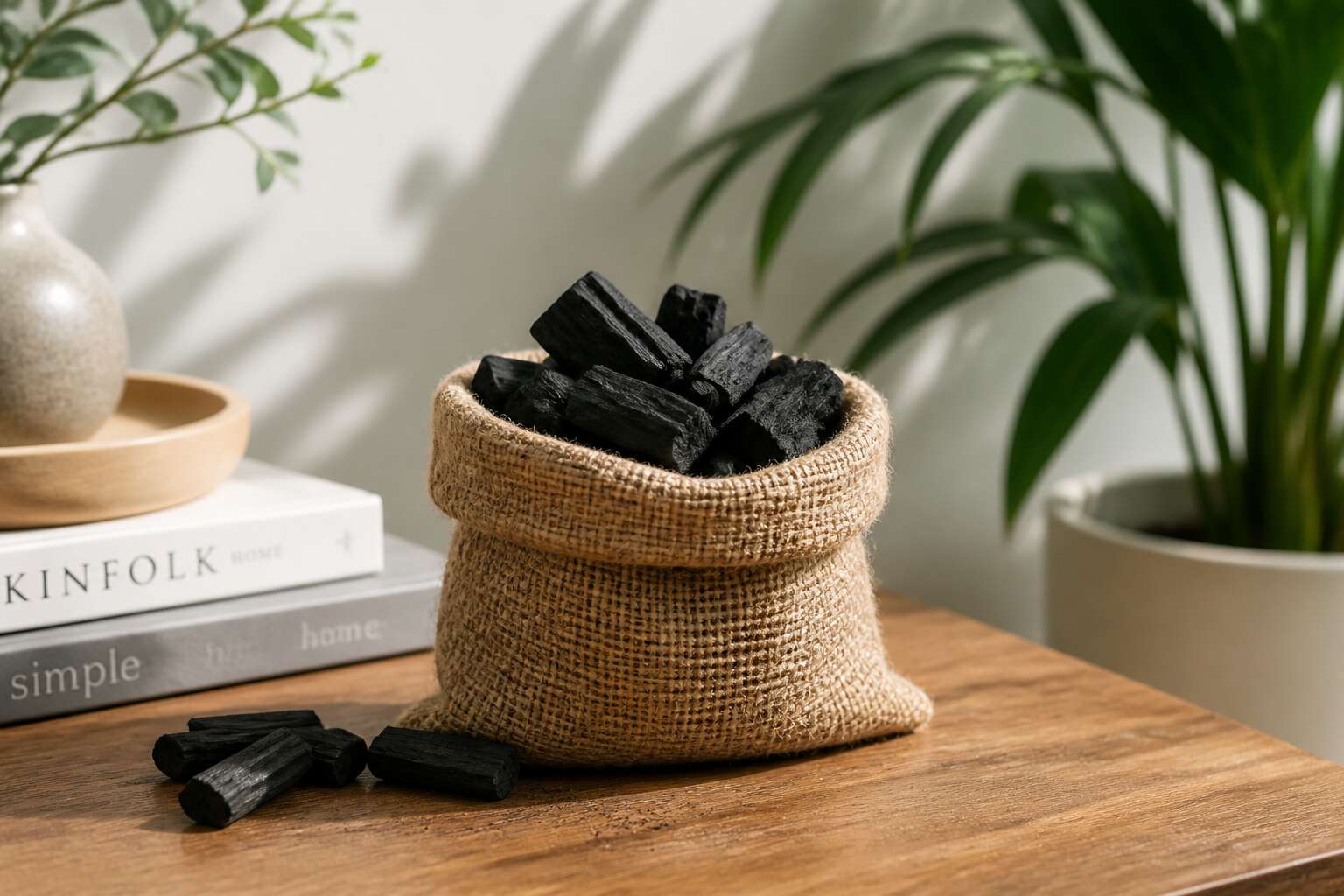
Understanding Activated Charcoal and Odor Absorption
What Is Activated Charcoal?
Most deodorisers mask unpleasant scents. Activated charcoal, by contrast, quietly removes them from the air. The material starts as coconut shells or wood, then undergoes high temperature treatment with oxygen. This activation creates a labyrinth of microscopic pores across its surface.
Those pores are the secret. One gram of activated charcoal can expose more than a thousand square metres of surface area. Odour molecules bind to these tiny spaces through a process called adsorption. They become trapped and effectively disappear from your environment.
Common problem areas include:
- Car boots with lingering gym kit smells
- Cupboards housing damp linen
- Pet corners that never quite air out
For these everyday nuisances, activated charcoal to absorb smells offers a straightforward, reusable solution. Simply place a pouch nearby, and let physics do the rest.
The Science of Adsorption vs. Absorption
Absorption and adsorption sound alike, but they operate on different principles. Absorption pulls a substance into an interior volume. Adsorption holds that substance on a surface. Activated charcoal to absorb smells relies on adsorption. The pore walls of each granule offer binding sites for odour molecules.
This distinction affects performance. Once charcoal reaches its adsorption capacity, it stops capturing new smells. Absorption, in contrast, continues until the whole material is saturated. Adsorption fills only the active surface layer. That is where the two diverge!
- Odour particles travel through the air
- They collide with pore walls
- Weak intermolecular forces keep them secure
No liquid enters the charcoal. No chemical change occurs. The process holds particles in place, which is why a pouch can freshen a confined area for months.
Why Activated Charcoal Is Effective at Trapping Odors
Some smells refuse to leave. A damp Cape Town winter seeps into wardrobes. Braai smoke settles into curtains. The source vanishes, yet the odour remains, an invisible presence that outlasts its own origin.
Activated charcoal to absorb smells changes this. I have seen it work in spaces where sprays had already failed. It does not perfume the air or hide the problem. It removes the particles you can smell, locking them away inside a structure that never wets, never reacts, and never leaks back.
Consider what that means in daily life:
- A pouch in a shoe rack keeps a hallway neutral
- A sachet in a linen cupboard protects towels between washes
- A larger bag in a workshop handles paint and solvent fumes
This is the quiet effectiveness of charcoal. It does the work without attention, for months on end, and you simply notice that the air got cleaner!
Best Applications for Activated Charcoal Odor Removal
Home Odor Control: Closets, Refrigerators, and Bathrooms
A single gram of activated charcoal contains over 3,000 square meters of internal surface area. That porous structure traps volatile compounds with efficiency. In closets, it neutralizes musty odors from shoes and stored fabrics. Refrigerators benefit because ethylene gases and spoilage scents fade quickly. Bathrooms present damp, recurring challenges, yet charcoal handles them without synthetic perfumes.
Placement matters for airflow. Three zones in a house respond especially well:
- Hanging near clothes in a closet.
- Behind the crisper drawer in a refrigerator.
- On a dry shelf in a bathroom.
When you use activated charcoal to absorb smells in these spots, the results appear within days. For South African homes affected by humidity and warm storage, this passive method offers dependable freshness.
Car and Vehicle Odor Elimination
South African summers push parked cars to extreme temperatures. Heat bakes spilled coffee, sweat, and takeaway grease into upholstery, and the smell lingers long after the source is gone. That is where activated charcoal to absorb smells proves its worth beyond the home!
A cloth bag under a seat or a small pouch on the dashboard works quietly. It captures volatile compounds directly. The porous structure traps what heat releases from carpets and headliners.
For vehicles with persistent problems:
– Petrol fumes from a leaky seal
– Cigarette smoke embedded in fabric
– Damp mustiness after wet seasons
The charcoal keeps working until it reaches capacity, then you replace it. No batteries. No refills. Just a simple material doing a straightforward job.
Shoes, Gym Bags, and Sports Equipment
The moment you unzip a gym bag after a long day, the odor arrives before the contents. It is a physical record of neglect, a mix of sweat and damp that no spray can truly erase. I have learned that activated charcoal to absorb smells works differently. It does not mask. It removes the particles themselves.
Shoes are the quiet offenders. A pair left in a car boot for a week develops a presence. Charcoal pouches inside the shoes draw out the compounds while you sleep. The same applies to cricket pads, hiking boots, and even those canvas sneakers you wore through a Joburg summer.
Consider what lingers:
- Moisture from wet socks
- Bacteria breaking down oils
- Plastic liners that trap heat
Charcoal handles each one without effort. It asks nothing from you. Nothing at all. This is activated charcoal to absorb smells, working quietly in the background.
Pet Odors and Litter Boxes
Pet odors attach to a home with persistence. The litter box releases ammonia, while pet beds and crates hold onto bacteria from fur and saliva. These sources do not respond to sprays that mask. Activated charcoal to absorb smells works by pulling the particles out of the air and holding them in its porous structure.
Consider where the smell comes from. The tray, the corners where pets mark, and the padding inside carriers each generate distinct compounds. One treatment addresses all of them.
- Place charcoal sachets under the litter tray
- Set a pouch inside the dog crate
- Hang one near the pet sleeping area
This approach reduces the need for frequent deep cleaning. The charcoal continues working for weeks, making it a reliable option for households with multiple animals.
Camping and Outdoor Gear
That musty smell creeping from your tent bag is not a memory. It is living bacteria and fungal spores breeding in the fabric folds. An overnight hike on Table Mountain leaves gear damp, and a closed backpack becomes a dark incubator. Activated charcoal to absorb smells disrupts this cycle entirely.
Each sachet provides a dry, porous environment that traps the volatile compounds responsible for mildew and stale odours. Unlike washing, which redistributes moisture, charcoal eliminates the problem at the source.
Placement matters for protection:
– Inside the sleeping bag storage sack
– Taped to the underside of the tent rainfly
– In the pocket of your hiking backpack
These small additions mean your Cape winter camping trips start with fresh gear, not a lingering stale greeting.
Office and Workspace Freshness
According to the EPA, indoor air can be five times more polluted than outdoor air. In an office, that translates to lingering curry, damp raincoats, and the mysterious scent of a forgotten banana. Activated charcoal to absorb smells works quietly in the background, capturing volatile compounds without perfumed cover-ups.
Consider these discreet placements:
- Inside filing cabinets
- Behind desk monitors
- Under communal coffee stations
The office is a social contract. Your sachet of charcoal does not announce itself. It simply allows the next meeting to start with fresh air instead of an olfactory argument.
How to Use Activated Charcoal for Maximum Effectiveness
Choosing the Right Form: Loose Granules, Bags, or Blocks
Activated charcoal to absorb smells works only when you match the form to the space. Loose granules excel in tiny enclosed areas, yet they need a breathable container. Bags offer convenience, but they saturate quickly under heavy odor loads. For persistent smells across a large room, blocks provide steady performance.
Consider these practical differences:
- Loose granules for small volumes like jars or shoe boxes
- Bags for moderate spaces such as cupboards
- Blocks for larger zones like storage rooms
Activated charcoal to absorb smells requires periodic reactivation. Sunlight draws out trapped odors, though repeated exposure reduces efficiency. I find that a single block with adequate airflow outperforms several bags in confined spots. Pay attention to surface area and ventilation. These factors decide whether the charcoal truly works.
Placement Strategies for Optimal Airflow
Placement determines whether activated charcoal to absorb smells reaches its full potential. Air must move across the charcoal surface for adsorption to happen. Stagnant pockets trap odors in corners, so position the charcoal where breezes naturally flow.
Elevate the charcoal above floor level. Odors settle low, but air near windows and doors moves more actively. I place bags near vents or along walls where circulation is steady.
A few airflow principles matter:
- Keep charcoal away from walls, leaving open space around the container
- Position near the odor source, not the room’s center
- Angle the charcoal toward open windows or doorways
When airflow stalls, performance drops. Moving air delivers fresh odor molecules to the charcoal surface, and adsorption rates climb. Even a small fan shifts the result. Activated charcoal to absorb smells rewards patience, but only when the air reaches it.
Recharging and Reusing Activated Charcoal
Activated charcoal eventually reaches a saturation point. The pores fill, and the steady adsorption rate drops. Instead of discarding the material, restore it with heat. Bake the charcoal at 200°F for two hours. This drives off trapped compounds and reopens the pore structure.
Cooling is mandatory. Placing hot charcoal back into a confined space releases the very odors it captured. I let mine rest on a baking sheet for at least an hour. Recharge monthly for consistent results.
- Spread the charcoal in a single layer on an oven tray.
- Heat to 200°F for two hours.
- Cool completely before reuse.
Most charcoal survives several cycles before losing effectiveness. This makes activated charcoal to absorb smells a practical long term investment for homes and vehicles.
Comparing Activated Charcoal to Other Odor Absorbers
Baking Soda vs. Activated Charcoal
Baking soda has long been the household default for taming stale smells, yet its chemistry only neutralizes certain acids. Activated charcoal to absorb smells works through physical adsorption, trapping odorous molecules within its porous structure. This distinction matters in humid climates like Durban’s, where baking soda cakes and loses potency. Charcoal bags, by contrast, continue working even when moisture is high.
- Baking soda reacts with specific compounds, while charcoal captures a broader spectrum.
- Baking soda requires frequent replacement; charcoal can be recharged in sunlight.
That longevity saves money over time. For persistent odors in cars or gym gear, the choice becomes clear to me!
Vinegar and Commercial Air Fresheners
Vinegar trades one scent for another. It neutralizes alkaline molecules like pet urine, but the acetic acid itself lingers for hours. Commercial air fresheners go further, coating nasal receptors with synthetic compounds. That is why the “fresh” scent fades within minutes. Activated charcoal to absorb smells operates on a different principle: adsorption. Odor molecules are captured inside its pore structure, not masked or replaced.
Consider what each product leaves behind:
- Vinegar: acidic residue that can corrode certain surfaces.
- Spray fresheners: volatile organic compounds that may trigger sensitivities.
- Charcoal bags: nothing but trapped odor molecules.
This is why activated charcoal to absorb smells has become my go to for persistent issues! The others only postpone the problem.
Frequently Asked Questions About Activated Charcoal for Odor Control
How Long Does Activated Charcoal Last?
People ask this the moment they unbox a pouch. The honest answer? Activated charcoal to absorb smells keeps working for roughly two to six months, depending on the load. I have had one bag fail in three weeks inside a smoker’s car and another last six months in a linen cupboard.
Three variables determine the lifespan.
– Still air saturates faster.
– Humidity clogs the pores prematurely.
– A litter box demands more from the carbon than a shoe rack.
Once the charcoal saturates, it is not expired, just full. Recharging is possible, but that is a separate topic. For now, know that this material has a finite lifespan.
Can You Wash Activated Charcoal?
Can you wash activated charcoal to absorb smells? The short answer is no, and attempting it can permanently ruin the material. Water molecules crowd into the micropores that trap odor compounds. Once that moisture moves in, the carbon has nowhere left to store smells. The adsorption sites are effectively sealed off.
Some people insist on rinsing bags under a tap. I have tested this myself with disappointing results! The odor returns within days because the trapped molecules never actually leave. They simply shift around.
Washing fails for three reasons:
- Tap water leaves mineral residues behind
- Detergents clog pore openings
- Trapped volatile compounds resist displacement by water
Drying in the sun does not restore the original pore volume. A washed pouch of activated charcoal to absorb smells loses capacity with each rinse. The material is better replaced than revived.
Is Activated Charcoal Safe for Pets and Children?
Many South African families ask whether activated charcoal to absorb smells is safe around curious toddlers and playful pets. The answer is reassuring. Activated charcoal is generally inert and non toxic. It passes through the digestive system without being absorbed into the bloodstream.
That said, the physical form matters. Loose granules can become a choking hazard for small children. A punctured bag might spill black dust that stains carpets and upholstery. Pets may chew on the fabric pouch out of curiosity. I have seen this happen with my own dog!
Common safety considerations include:
- Infants exploring with their mouths
- Dogs that tear open soft packaging
- Placement near floor level where children play
The key concern is mechanical, not chemical. Activated charcoal to absorb smells poses minimal risk when contained properly.
Does Activated Charcoal Remove Moisture and Odors?
A frequent question I encounter is whether activated charcoal to absorb smells also clears moisture. It does not. The porous structure targets odor molecules, not water vapor. High humidity actually fills those microscopic pores with water, which blocks adsorption and dulls the effect.
This matters in coastal parts of South Africa where dampness lingers. When you use it in a humid bathroom, you are treating the odor, not the dampness. You still need airflow to address the source. However, once the air dries out, the same charcoal resumes working normally.
- Musty smell returns quickly after recharging
- Bag feels damp or heavy
- Moisture droplets visible on the fabric pouch
Where Can You Buy Activated Charcoal for Odor Elimination?
For South African shoppers, the hunt for activated charcoal to absorb smells often ends at unexpected corners. Hardware stores stock it for filter systems, while health shops sell capsules that are useless for your closet. Online marketplaces like Takealot and Yuppiechef offer dedicated odor bags, but check the weight. A 200 gram pouch treats a small wardrobe; larger spaces demand more. Pet shops also carry charcoal products for litter boxes, though some are scented. Avoid those. The key is choosing unadulterated carbon, whether loose granules or sewn pouches. Here is where you might find it:
- Builders Warehouse and similar chains
- Specialty eco stores
- Amazon via international shipping
Just be mindful of import costs. Local suppliers often provide better value, and you support the economy while freshening your home. That is a win, or at least a neutral trade.



0 Comments