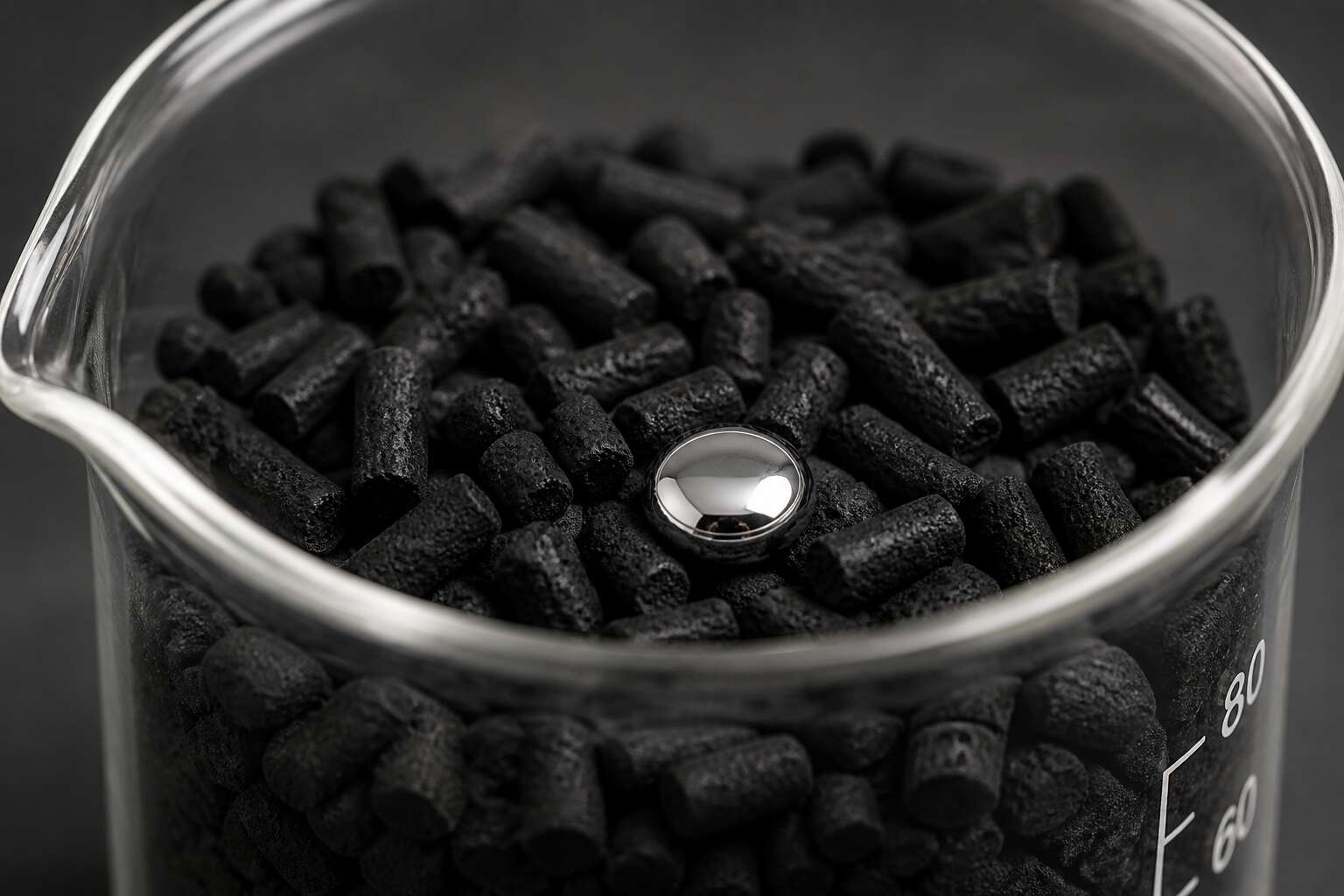
The Science of Adsorption and Why Mercury Defies It
The Fundamental Difference Between Adsorption and Absorption
Adsorption is a surface phenomenon, whereas absorption involves the entire volume of a material. This distinction is more than semantics. It explains why activated charcoal cannot adsorb mercury in real world scenarios.
- Adsorption binds molecules to the outer surface of a sorbent.
- Absorption draws a substance into the sorbent’s inner matrix.
- Charcoal relies exclusively on adsorption.
Liquid mercury resists this binding with astonishing cohesion. Its atoms cling to one another with metallic bonds, far stronger than the weak van der Waals forces charcoal can offer. Instead of adhering to the carbon, mercury beads up and flows through the pore network untouched. For South African water treatment plants, this physical reality shapes how engineers approach mercury removal.
Physical Adsorption vs. Chemical Adsorption
Mercury bonds to itself, not to carbon, and that simple fact decides everything. The science of adsorption splits into two distinct mechanisms. Physical adsorption relies on weak van der Waals forces between molecules. Chemical adsorption requires electron transfer and the formation of new atomic bonds. Most waterborne contaminants trigger at least one of these pathways on carbon surfaces. Mercury triggers neither.
- Physical adsorption: weak intermolecular attraction, reversible, low energy.
- Chemical adsorption: strong atomic bonds, irreversible, high energy.
Mercury atoms hold their electrons tightly, refusing to share with carbon. The metallic bonds between mercury atoms exceed charcoal’s physical attraction by a considerable margin. I recall pilot tests where mercury-laden water exited carbon columns virtually unchanged, a frustrating outcome for engineers across South Africa. This explains precisely why activated charcoal cannot adsorb mercury in real world filtration systems.
Pore Size Distribution and Mercury’s Atomic Radius
Adsorption science requires a molecule to prefer the carbon surface over its own kind. Mercury does not. The metallic bonds between mercury atoms demand high energy, and charcoal’s weak dispersive forces cannot compete. I have watched pilot tests in South Africa show mercury exiting carbon columns unchanged. This is precisely why activated charcoal cannot adsorb mercury in any practical filtration context.
Mercury’s atomic radius measures approximately 151 picometres, which fits within the typical pore size distribution of activated charcoal. Yet the pore network is irrelevant because the fundamental attraction never occurs. Without an electron transfer or a strong physical bonding mechanism, the mercury atom simply stays in solution, indifferent to the carbon’s porous architecture.
Why Van der Waals Forces Are Insufficient for Mercury
Van der Waals forces are the weakest form of molecular courtesy. They work for light molecules that have little else to offer, but mercury is simply too self-contained. Its metallic bonds require energy that charcoal’s dispersive forces cannot approach. This is precisely why activated charcoal cannot adsorb mercury. The attraction never starts.
The science of adsorption demands that a molecule prefer the carbon surface over its own kind. Mercury prefers its own kind every single time! I have watched this behaviour in field applications in South Africa, where mercury exits carbon columns exactly as it entered.
The Chemistry of Mercury and Activated Charcoal
Mercury’s Electron Configuration and Inertness
Mercury’s electron configuration explains its stubborn refusal to bond. The element carries a full 6s² subshell followed by a filled 4f¹⁴ 5d¹⁰ core. This arrangement leaves no unpaired electrons available for chemical interaction. I have seen activated charcoal fail time and again in mercury applications, and the chemistry tells us why. Relativistic effects pull mercury’s electrons close to the nucleus, creating a cloud that resists disruption. The atom is content as it is.
– The closed shell demands high energy before any electron transfer occurs
– The inertness prevents chemisorption from taking hold on carbon surfaces
– Mercury remains elemental even when trapped inside pore networks
This is precisely why activated charcoal cannot adsorb mercury. The charcoal’s surface chemistry offers opportunities for bonding, but mercury’s inert configuration blocks every advance. It stays aloof, refusing to react.
The Lack of Reactive Functional Groups on Activated Carbon
Activated charcoal’s surface is not a chemically reactive one. Most commercial grades carry few functional groups capable of binding metals. Oxygenated species such as carboxylic and phenolic sites do appear, but they show no affinity for elemental mercury atoms. This is why activated charcoal cannot adsorb mercury; the surface lacks the necessary chemistry to seize the atom.
Standard activated carbon is missing the functional groups needed for mercury capture:
- Thiol groups, which form strong mercury sulfur bonds, are absent.
- Amine groups, useful for metal coordination, are not present on untreated carbon.
- Ion exchange sites do not exist on the carbon surface.
The mercury atom encounters a chemically indifferent surface. Chemisorption cannot take hold, and physical forces are too weak, as shown earlier. Without reactive functional groups, the carbon cannot bind the metal.
Why Ionic Mercury (Hg2+) and Elemental Mercury (Hg0) Behave Differently
Mercury in the environment exists in two forms, and neither clings to carbon. Elemental mercury, Hg0, is electrically neutral and nonpolar. The carbon surface offers no site that can attract the atom, so it passes through the pore network without sticking.
Ionic mercury, Hg2+, seems the more likely candidate. A double positive charge should seek out anionic sites. Yet in solution, Hg2+ is never a naked ion. A shell of water molecules surrounds it, expanding its diameter beyond the reach of most micropores. Natural waters also contain chloride and hydroxide ligands that bind Hg2+ into neutral complexes such as HgCl2 and Hg(OH)2.
- Hg0 is nonpolar and inert, with no affinity for carbon surfaces.
- Hg2+ in solution is hydrated and too large for micropores.
- Ligand complexation neutralizes Hg2+ in most natural waters.
This is the chemical essence of why activated charcoal cannot adsorb mercury. The charged ion is shielded, and the neutral atom is unreactive. Neither establishes the strong chemical bond required for retention.
The Role of Competitive Ions in Aqueous Solutions
In any real water body, mercury never arrives alone. The same liquid carries calcium, magnesium, sodium, and a host of other dissolved salts. These ions swarm the activated charcoal surface, occupying the very sites where adhesion could theoretically occur. Their smaller ionic radii and higher concentrations mean they reach the pores first and stay there. Mercury, already hindered by its hydration shell, finds no vacant space.
Competitive ions also alter mercury’s chemical form. Chloride complexes, especially in brackish or estuarine waters, shift mercury into neutral species that behave like dissolved gases. These complexes resist the weak forces charcoal offers. This interplay of ionic competition and speciation explains why activated charcoal cannot adsorb mercury in most practical filtration settings.
Medical and Clinical Limitations of Activated Charcoal for Mercury
Why Poison Control Centers Do Not Recommend It for Heavy Metals
South African poison control centres field hundreds of heavy metal calls each year. Yet activated charcoal rarely appears in mercury cases. Charcoal given orally moves through the gastrointestinal tract without binding mercury in the blood or organs. It cannot reach mercury already absorbed into tissues. For ingested mercury salts, clinical data show no meaningful binding in the gut.
Clinical guidelines reflect this. Poison control centres do not recommend activated charcoal for heavy metals like mercury because the expected benefit is negligible and the intervention can delay treatment.
Points from the clinical record:
- Charcoal has no effect on inhaled mercury vapour, the most common occupational exposure route.
- Liquid mercury ingestion is poorly absorbed, making charcoal unnecessary.
- Soluble mercury salts adsorb too weakly and too slowly to alter the clinical course.
This is why activated charcoal cannot adsorb mercury. Time spent on charcoal is time lost for chelation.
The Ineffectiveness of Charcoal for Methylmercury and Inorganic Mercury
Consider what actually unfolds in clinical practice. Methylmercury crosses the intestinal barrier with alarming efficiency, often exceeding ninety percent absorption. By the time a charcoal slurry reaches the stomach, that mercury has already entered the bloodstream and migrated toward the brain and kidneys. Charcoal remains in the gut, blind to what has left it.
Inorganic mercury presents a different failure. Mercuric salts burn the gastrointestinal mucosa immediately on contact. The tissue damage is corrosive, not adsorptive. No carbon particle can reverse that injury.
The sequence matters here:
1. Ingestion occurs.
2. Absorption follows within minutes.
3. Charcoal arrives too late.
4. Clinicians turn to chelation.
This is why activated charcoal cannot adsorb mercury in any way that alters patient outcomes. The clinical evidence, gathered from real exposure cases, points the same direction every time.
Time-Dependency: Why Charcoal Fails in Post-Absorption Scenarios
The timeline of mercury poisoning never favors charcoal. Within minutes of ingestion, mercuric compounds cross the intestinal wall and enter the bloodstream. The charcoal remains in the gut with open pores, but the metal has already moved into tissues.
- Absorption outpaces gastric decontamination
- Charcoal only acts within the lumen, never the blood
- Post-absorption, no carbon particle retrieves mercury
Clinical reality follows this grim sequence. The window for activated charcoal narrows with every heartbeat, and emergency rooms rarely catch it. This temporal defeat is why activated charcoal cannot adsorb mercury in scenarios where the body has already absorbed the poison. Chelation remains the last instrument, not charcoal!
Alternative Treatments: Chelation Therapy and Its Mechanisms
Clinicians in South Africa rarely reach for charcoal when mercury is suspected. The medical chart reveals a hard truth: activated charcoal is a gastrointestinal sorbent, but mercury moves quickly into the vascular compartment. Once systemic, carbon particles offer no salvage path. I have seen protocols shift entirely toward metal-binding agents in these acute cases.
The clinical alternative, chelation therapy, hinges on a different chemistry. Chelators such as DMSA contain thiol groups that form covalent bonds with mercury ions. This binding strips the metal from biological proteins, creating a renal-excretable chelate. This is precisely why activated charcoal cannot adsorb mercury: it lacks the ligand specificity to compete with these binding sites, whereas chelators possess a high affinity for the toxic ion.
- Oral chelators require precise timing to avoid adverse interactions.
- Parenteral chelation demands close monitoring for nephrotoxicity.
- Treatment selection depends on the mercury species and renal function.
The mechanism is unambiguous. Charcoal sits inert while chelation mobilizes the poison from tissues, converting a lipophilic threat into a water-soluble one!
The Danger of Misinformation and DIY Detox Claims
In my practice, a patient once arrived clutching a bottle of charcoal capsules, convinced they were detoxifying from amalgam exposure. They were weeks past the exposure, and the mercury had already entered their tissues! This illustrates the clinical gap and the reason why activated charcoal cannot adsorb mercury once systemic. The sorbent acts only within the gut lumen.
The danger is misinformation. Turning to charcoal for mercury toxicity creates a false sense of security, delaying medical intervention. Since it has no vascular reach, it offers zero benefit to a poisoned patient.
- Charcoal lacks the targeted affinity to strip mercury from biological proteins.
- It cannot penetrate the bloodstream where the metal accumulates.
- Its availability encourages a DIY approach that is clinically baseless.
This is why activated charcoal cannot adsorb mercury in any practical scenario. The medical literature is definitive, yet online detox protocols persist, exposing South African patients to preventable harm.
The Role of Functionalized Charcoal and Other Adsorbents
Can Sulfur-Infused Modified Charcoal Adsorb Mercury?
Here is a sobering truth: sulfur-infused modified charcoal is the eager intern of the adsorption world, always promising great things but often underdelivering. The chemistry seems sound, as sulfur binds tightly to mercury. However, the actual performance depends on the sulfur’s physical placement and the reactive surface area left unobstructed. In practice, most sulfur-impregnated carbons suffer from blocked pores or uneven coating. This helps clarify why activated charcoal cannot adsorb mercury effectively, even when dressed up with extra elements.
Other adsorbents also enter the ring, but each carries luggage. Consider these alternatives:
- Thiol-functionalized mesoporous silicas, which boast high capacity but require precise pH control
- Metal sulfides like iron sulfide, which work in oxygen-free settings only
- Polymeric resins with chelating groups, which struggle with elemental mercury in gas phases
The real kicker is that these materials often handle synthetic solutions beautifully, then fail in real South African water samples. Sulfur-infused charcoal might catch vapor-phase mercury, but dissolve the same compound in water, and things get messy. That, my friend, is the unglamorous truth behind why activated charcoal cannot adsorb mercury.
Comparing Activated Charcoal with Biochar and Engineered Nanomaterials
Activated carbon can pack 1,000 square meters into a single gram, yet those surfaces remain inert. Functionalized charcoal tries to fix this by adding nitrogen or oxygen groups to create binding sites. That addition often shrinks the pores. This structural change explains why activated charcoal cannot adsorb mercury: the added groups occupy space, so mercury ions cannot reach the reactive centers.
Biochar presents a different profile. Its lower processing temperature leaves residual organic matter, which either aids or blocks adsorption depending on feedstock. Engineered nanomaterials, such as titanium dioxide and nano zero-valent iron, show high mercury uptake, but they aggregate without stabilizers. South African source water compounds the problem.
- Functionalized charcoal: higher affinity, reduced surface area
- Biochar: variable performance based on pyrolysis conditions
- Engineered nanomaterials: fast kinetics, difficult handling
Thiol-Functionalized Carbon Surfaces: A Promising Research Direction
Mercury and sulfur have a well-documented relationship. Inorganic mercury binds tightly to thiol groups, which is why researchers are attaching sulfur-containing molecules to carbon surfaces. This approach addresses the core problem directly. The reason why activated charcoal cannot adsorb mercury is the absence of chemical binding sites, and thiol groups add exactly that.
Early results show promise. Thiol-functionalized carbons can pull mercury from water at rates that plain charcoal cannot match. The difficulty lies in synthesis. Attaching thiol groups without collapsing the pore structure requires careful processing, and some methods sacrifice surface area for affinity. I have followed this research closely. That tradeoff matters, but the progress is real!
Research directions include:
- Grafting thiol groups onto activated carbon via silane coupling agents
- Using sulfur-rich precursors during carbonization
- Testing regenerability after mercury binding
South African water treatment facilities face mercury contamination from mining operations, making this research especially relevant to local conditions.
The Difference Between Adsorption Capacity and Selectivity
Capacity tells you how much a material can hold. Selectivity tells you what it chooses to hold. Plain activated carbon has decent capacity for many contaminants, but it lacks selectivity for mercury. This is why activated charcoal cannot adsorb mercury; the surface has no binding sites that prefer mercury over competing ions.
Functionalized charcoal changes this. Grafting thiol groups onto the surface creates a material that actively selects mercury. Other adsorbents build on the same idea. Sulfur-impregnated resins, modified zeolites, and certain clays all use specific binding chemistry.
This distinction shapes real water treatment decisions:
- High-capacity, low-selectivity materials fill up with the wrong compounds
- Lower-capacity, high-selectivity materials pull mercury from complex water
- South African plants need both, but selectivity is the harder problem to solve
In my work, a material can hold a lot and still fail at mercury removal. The reverse is also true. Selective adsorbents may hold less overall, but they hold what matters.
Regulatory Standards and Practical Water Filtration Applications
South African water utilities face a stubborn problem. The question of why activated charcoal cannot adsorb mercury becomes urgent when treating runoff from gold mines and coal plants. Standard carbon filters miss mercury entirely while other contaminants bind readily. Functionalized charcoal changes this by adding thiol groups that actively grab mercury ions.
Regulatory standards under SANS 241 set mercury limits at 0.006 mg/L. Municipal plants must prove compliance or face penalties. Practical filtration systems in Mpumalanga and Gauteng respond with selective media:
- Thiol-grafted carbons for ionic mercury in wastewater
- Sulfur-impregnated resins for complex industrial streams
- Modified zeolites where regeneration matters
Operators see the difference daily. A filter packed with plain carbon removes odours and organics, then lets mercury slip through. Understanding why activated charcoal cannot adsorb mercury guides better equipment choices and protects communities downstream.


0 Comments